You are not ruined.
You are under reconstruction.
A healing and reflection brand for the woman learning how to rebuild her identity, self-worth, softness, faith, and emotional truth after survival.

Built from truth. Rebuilt in grace.
You were never supposed to carry it all.
Strength was never supposed to look like silence, over-functioning, and “I’m fine.” You can set it down here.
Healing is holy work — and it is work.
Softness does not mean passive. Reconstruction is the most disciplined thing you will ever do — and the most worth it.
You are not starting over.
Every scar taught you something reconstruction gets to keep. Same stones — rebuilt on truth instead of performance.
The strong one for everyone else.
The fixed one. The fine one. The one everyone leans on — and no one checks on.
You don’t have to prove you’re struggling to deserve support.
You only have to be honest.
The Divine Reconstruction Method
Six quiet movements — the order in which a woman returns to herself. No shortcuts. No spectators. Nothing to perform.
Awakening
You see yourself honestly — without shame, without performance. Awareness begins the reconstruction.
Release
You name what no longer serves you and put the weight down. Some endings are sacred beginnings.
Realignment
Patterns, reactions, and boundaries are corrected gently. Accountability without self-hatred is maturity.
Rebuilding
Worth is not earned — it is remembered. The foundation goes back by hand, one honest stone at a time.
Expansion
You grow through what you went through, and the lesson becomes wisdom you can live from.
Embodiment
Discipline becomes devotion to your future self. You walk as her — quietly, on purpose.
The rest is between you and the page.
Three movements. One reconstruction.
Release
Lay it down. The narratives you outgrew, the performance you perfected, the weight that was never yours to carry.
Rebuild
Pick up the true things. Boundaries, rhythms, honest reflection, disciplined softness — and a faith that holds.
Become
Walk in her — the woman you were before the world required you to perform, and the one she was always becoming.
You may not be in the same movement as anyone else. That’s allowed. That’s the point.
“What is being rebuilt in me is holy — and it does not owe anyone an explanation.”
From the Divine Reconstruction journalYour reconstruction can begin softly.
The 5-Day Soft Reconstruction Reflection by Seven Calia
A little room to pause. A page to tell yourself the truth. A gentle place to begin.

Tools for the road
Printable PDF companions for the rebuilding — structure and small sacred practices. Begin with one, or carry the set as it grows.
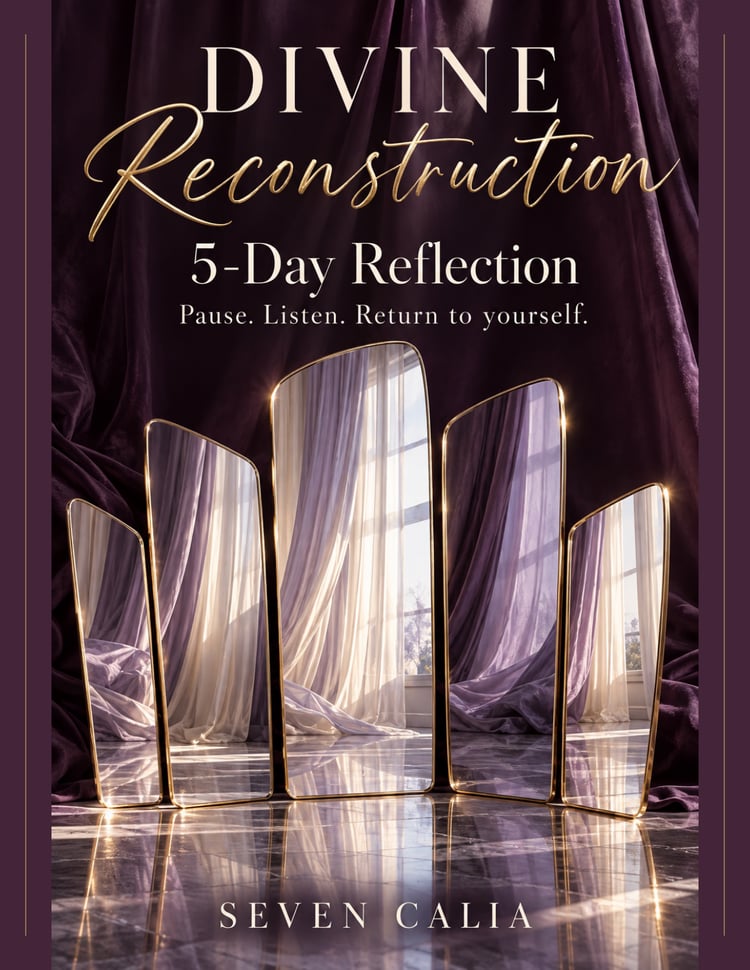 Free · 14-page PDF
The 5-Day Reflection
Five paired teaching and reflection days on truth, feelings, fear, worth, and self-reflection — pause, listen, and return to yourself.
Begin free ✦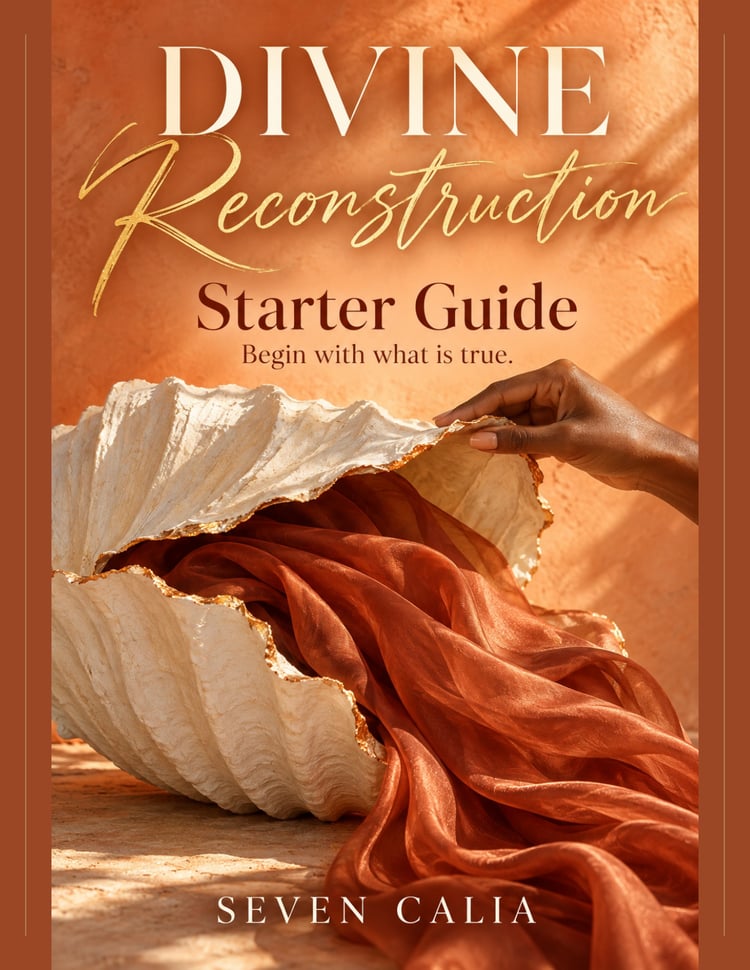 $9 · 7-page PDF
Starter Guide
Notice, release, protect, begin, and a closing reflection — a gentle entry point for rebuilding at your own pace.
Begin with what is true ✦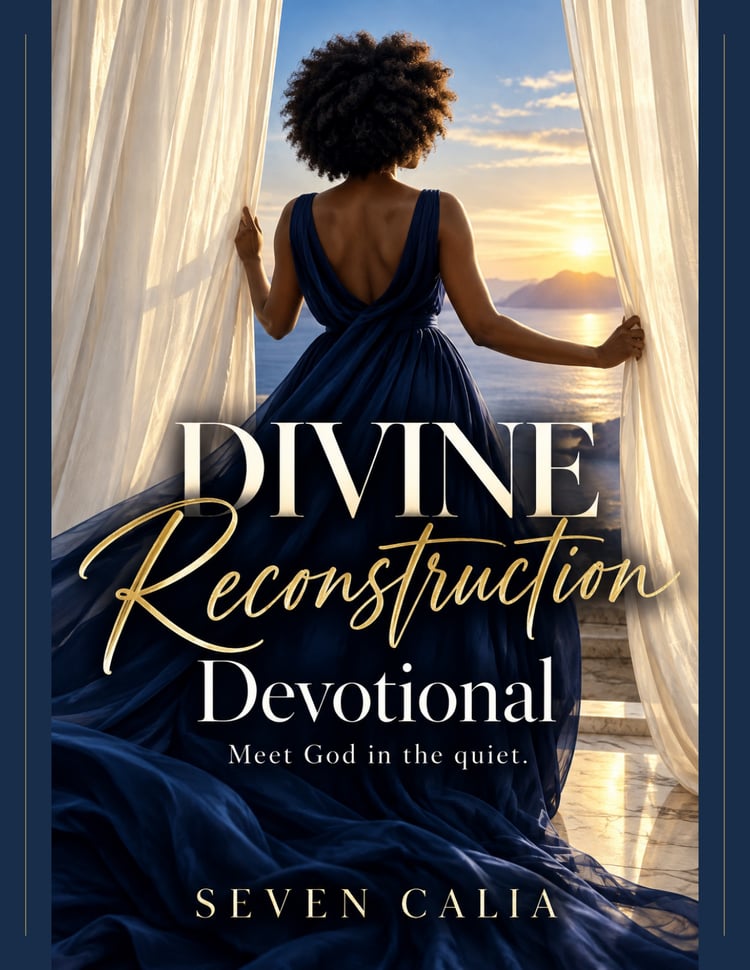 $15 · 18-page PDF
7-Day Foundation Devotional
A quiet seven-day rhythm of prayer, reflection, and modest action — meet God in the quiet places you keep avoiding.
Meet God in the quiet ✦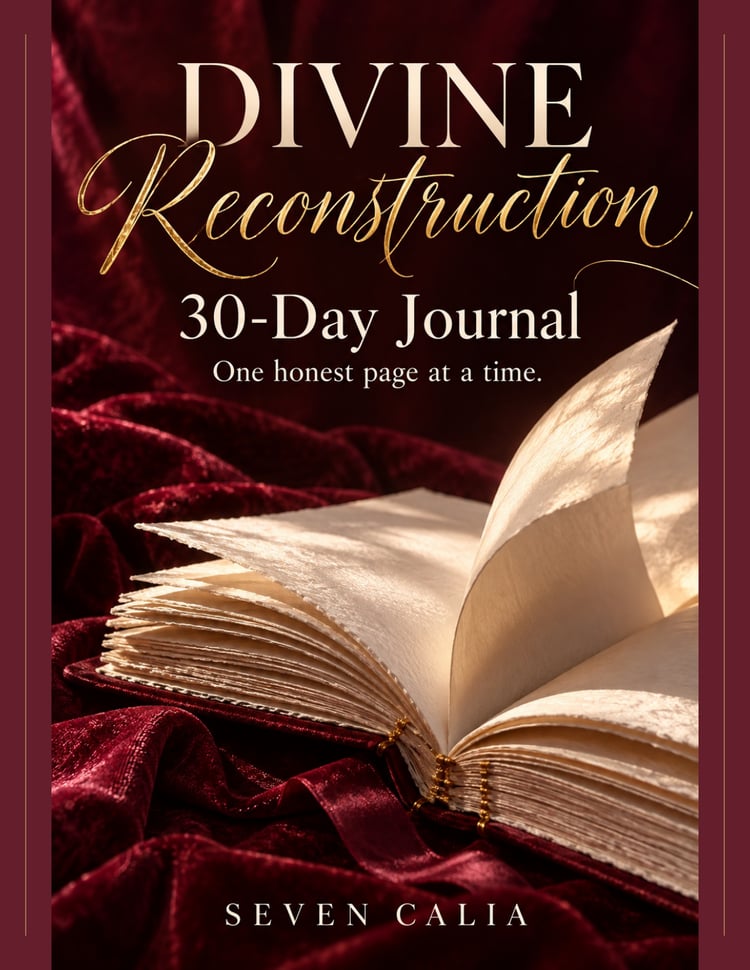 $29 · 73-page PDF
30-Day Reflection Journal
Thirty daily reading and writing pairs across the six phases of The Divine Reconstruction Method™ — one honest page at a time.
Start the 30-day journal ✦ $29 · 41-page PDF
The Ugly Truth Mirror Workbook
Eight focused sections on personal story, responsibility, patterns, repair, and evidence of reconstruction — with dignity, not shame.
Face what is true ✦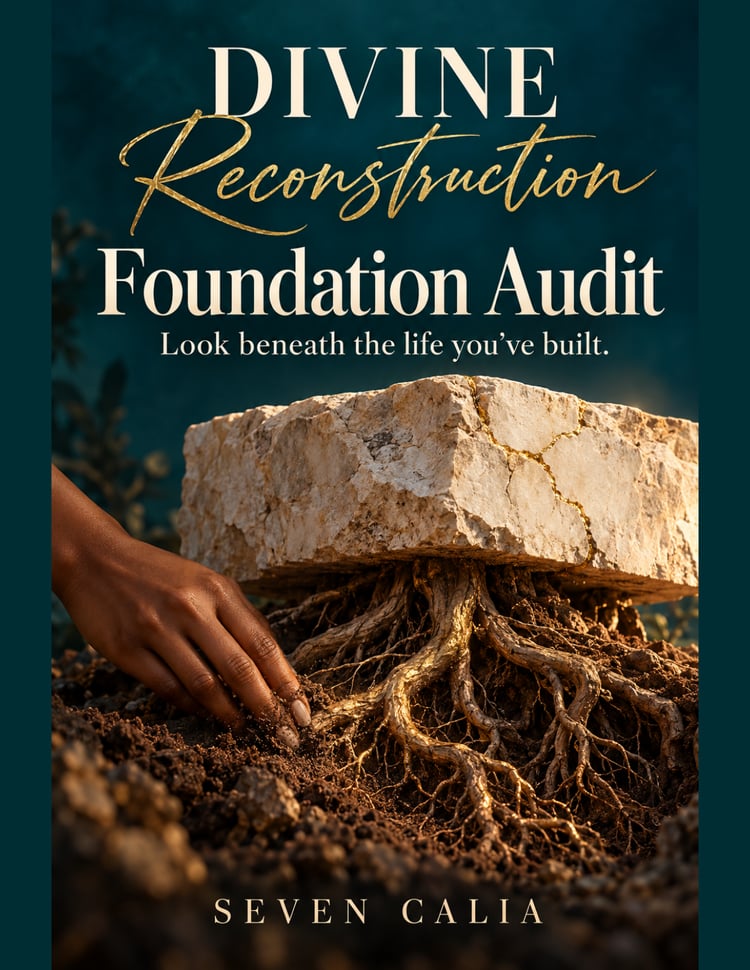 $19 · 23-page PDF
Foundation Audit
A soft place to tell the truth about what needs rebuilding — eight foundations, a gentle scorecard, and a reconstruction map.
Take the foundation audit ✦ $15 · 16-page PDF
Weekly Planner
Intentions, week-at-a-glance, Monday through Sunday pages, routines, boundaries, and an end-of-week review — planned around honest capacity.
Plan my week with peace ✦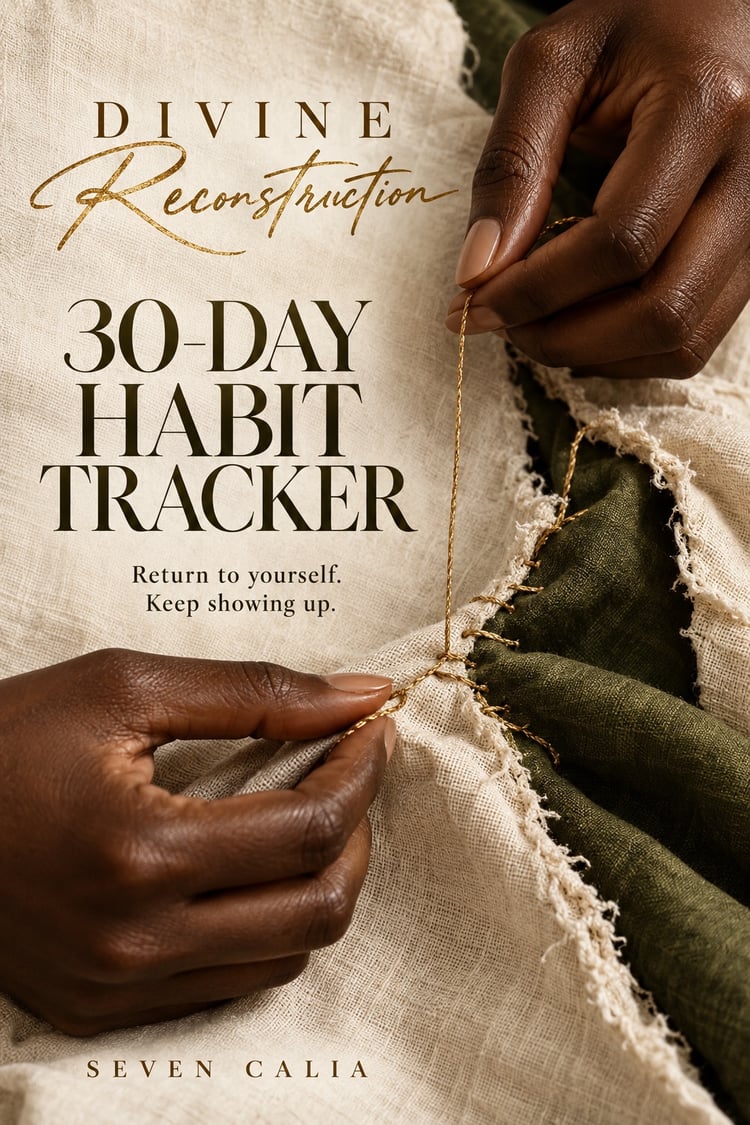 $9 · 11-page PDF
30-Day Habit Tracker
Choose one to three practices, track thirty days at a time, reflect at weekly check-ins, and restart after setbacks without shame.
Start tracking my habits ✦ $24 · 36-page PDF
The Black Sheep’s Guide
A raw, faith-rooted guide for the woman who has been through hell, lost herself, and still knows God is calling her higher.
Begin as the black sheep ✦Every product is a digital PDF download from the Divine Reconstruction shop — begin on any device, print what you write best on.
Connect with me
The reconstruction does not only live in the pages. Walk with me day by day — the reflections, the questions, and the community carry on between letters.
@divine.reconstruction — the daily word, the mirror moments, and the woman becoming.
Divine Reconstruction — where the conversation continues and no one rebuilds alone.
Threads
@divine.reconstruction — short reflections and honest questions, straight from the desk.
Say hello when you arrive — Seven reads the comments herself.
A journey back to you
begins with one honest sentence.
Built from truth. Rebuilt in grace.
Divine Reconstruction exists for one reason: so the strong one finally has somewhere soft and honest to land.
Divine Reconstruction began in the wreckage of being everyone’s strong one — after the heartbreak no one saw coming, the burnout no one believed, and the quiet loss of a self I had spent years performing for everyone else.
I didn’t need another voice telling me to stay strong. I needed somewhere to be honest. Somewhere that didn’t flinch at the truth, didn’t rush the healing, and didn’t require me to be further along than I was.
So I built it — journals, reflections, cards, conversations. A space where softness and discipline hold hands, faith comes without shame, and truth is treated as sacred instead of inconvenient.
If that’s the room you’ve been looking for, it’s yours now too.
What reconstruction means here
Reconstruction is not erasure. We don’t bulldoze what you lived — we read it honestly, keep what’s true, and release what was never yours to carry. You are not starting over. You are rebuilding, with intention, on a foundation that won’t collapse the next time life asks too much of you.
“To help women heal emotional wounds, rebuild self-worth, and embrace their divinely aligned identity through guided reflection, spiritual truth, and transformational tools.”
“To be the leading brand for women’s transformational healing — empowering women to break cycles, rise in alignment, and live the life they were created for.”
Seven Calia
Seven Calia is a writer, speaker, creator, and the spiritual voice behind Divine Reconstruction. Her work centers healing, self-awareness, emotional growth, divine worth, and one unshakable belief — women are not ruined by what they have survived. They are under reconstruction.
Published by Seven Calia Publishing.
Beauty for ashes
The work is anchored in Isaiah 61:3 — beauty for ashes, the oil of joy — and Isaiah 43:18–19: “Forget the former things… See, I am doing a new thing!” Healing is not becoming someone new. It is returning to who you were before pain convinced you that you were hard to love.
What everything here is built on
Truth
We name what happened, plainly and without decoration. You cannot rebuild on a lie.
Softness
Tenderness as strategy, not weakness. The gentle things hold longest.
Discipline
Healing is a practice. We keep the promises we make to the woman we’re becoming.
Faith
Anchored in God, never in fear. Prayer is part of the process here.
Self-awareness
We journal so the patterns stop hiding. Reflection is how we learn to see ourselves honestly.
Emotional maturity
We respond instead of perform. We feel all of it — and stay responsible for it.
A companion for reflection
- Guided journals, prompts and honest conversation
- A soft, disciplined space to rebuild — at your pace
- Prayer over performance, grace over shame
- Community for women who are done pretending
A replacement for real care
- Therapy or medical care. Please seek licensed support — you deserve it
- Toxic positivity — “good vibes only” is a lie we don’t tell
- Hustle healing or “just pray it away” formulas
- Fear-based faith, shame, or rushing your process
You are not starting over. You are reconstructing.
How to Use This System
Welcome to Divine Reconstruction. This is not just a journal — it is a guided rebuilding process designed to help you reconnect with yourself, heal what has been fractured, strengthen your foundation, and consciously create the next version of your life.
The Divine Reconstruction System is one journal, six phases, and the daily practice of telling yourself the truth. One complete reconstruction experience.
Reconstruction is not always comfortable.
Some days you will feel inspired. Some days you will feel challenged. Some days old wounds will surface. This is part of the process. Take your time. Trust the process. Honor your progress.
You are not returning to who you were. You are becoming who you were always meant to be.
— Seven Calia
The Divine Reconstruction Journal
A 60-day guided emotional reconstruction journey — part confession, part construction site, part sacred text.
“There comes a moment in life when the version of you that survived can no longer carry the version of you that is meant to evolve.” This journal was not created for perfection. It was created for reconstruction — sixty honest days of truth, softness, and the slow, sacred work of returning to yourself.
Sixty days. Six phases. One return.
Awakening
Awareness begins the reconstruction. See yourself honestly — without shame, without performance.
Release
Put down emotional weight and make room for peace. Forgiveness is release, not permission. Some endings are sacred beginnings.
Realignment
Become conscious of your patterns, reactions, and emotional responses — and realign them. Accountability without self-hatred is maturity.
Rebuilding
Reclaim your worth and rebuild your identity with intention. Worth is not something you earn — it is something you remember.
Expansion
Go through it to grow through it. Transform the pain. Alchemize the lesson into wisdom you can live from.
Embodiment
Live in the reconstruction with peace, purpose, and alignment. Discipline is devotion to your future self.

Every day holds eight doors
Reflection
A short, honest teaching opens each day — never a lecture, always a mirror.
Guided Prompt
One question that meets you where you are. No blank-page paralysis — ever.
Affirmation
A truth to speak over yourself. Words are spells — speak life.
Scripture or Quote
Anchored in the Word and wise voices — from Isaiah 61:3 to “know thyself.”
Emotional Check-In
Name what you actually feel today. Suppression leads to depression.
Self-Soothing Ritual
Tea in silence, mirror work, slow baths, hand-over-heart breathing, flowers for no reason.
Closing Reflection
“What did today reveal about who I am becoming?” — the day’s last honest sentence.
Writing Space
A two-page spread: guidance on the left, generous cream pages to pour on the right.
Every journal-space page opens the same way — “Today I choose to be honest with myself.”
Awareness begins the reconstruction
1Awareness is not shame. Awareness is freedom. You cannot heal what you refuse to acknowledge.
2Who did I become in order to survive? What masks did I develop because of rejection, abandonment, fear, or pain?
3I honor the version of me that did what it needed to do.
4Drink tea slowly tonight. Sit in silence, dim the lights, breathe deeply for five minutes — hand over your heart.
Day One theme: “Awareness begins the reconstruction.” Scripture: John 8:32 — “the truth shall make you free.”
The 10 Divine Reconstruction Principles
- Self-reflecting to self-correct.
- Know thyself.
- Suppression leads to depression.
- Go through it to grow through it.
- Discern the lesson within the test.
- Your life lessons do not define who you are as a person.
- No one can love you more than you love yourself.
- It is all for my highest good.
- Healing requires honesty.
- You are not ruined. You are under reconstruction.
The sacred extras
- Sacred Pause days — “Rest. Be. Restore. You are allowed to just be.”
- The Release Ceremony — safely burn or tear what you are ready to let go of
- Mirror work & breathwork — learning to see yourself lovingly
- Letter to My Future Self & My Vision Page
- Promises to Myself — seven promises for the woman you are becoming
- The Final Blessing — Day 60’s sacred closing
You did not come this far
to only come this far.
How to Rebuild Your Life with God After Everything Falls Apart — without pretending to be perfect
A raw, faith-rooted guide for the black sheep, the outcast, and the woman in the in-between who is ready to stop hiding, face her truth, and rise from the ashes.
The Black Sheep’s Guide to Divine Reconstruction
- Clarity in the chaos — identify what actually collapsed and why you feel stuck in the in-between.
- Truth without shame — face the patterns, coping habits, and hidden wounds that have kept you surviving instead of rebuilding.
- A God-centered reconstruction path — begin stepping into the woman you are becoming with honesty, courage, faith, and direction.
Secure checkout in the Divine Reconstruction shop. Instant digital delivery — read on any phone, tablet, or computer. Print it if you write better on paper.
Share what helped and what could be better. Positive and critical feedback are equally welcome. View product reviews on Payhip.
To leave a review, open the download link in your Payhip purchase receipt. Reviews appear publicly on the Payhip listing for The Black Sheep’s Guide — please avoid including sensitive personal details in what you share.
You are not crazy for feeling lost. You are not weak because you are grieving the woman you used to be. And you are not disqualified because your story is messy.
The Black Sheep’s Guide to Divine Reconstruction was created for the woman who has survived a tower moment, spiritual death, ego death, heartbreak, shame, isolation, or life collapse — and knows deep down that God is not finished with her.
This guide will help you stop numbing, stop pretending, and start rebuilding from truth.
This guide was built for the woman who does not fit the mold
- The black sheep who never quite belonged anywhere
- The rebel who got tired of pretending to be someone else
- The outcast who was judged, misunderstood, or counted out
- The woman who survived a tower moment, ego death, or spiritual winter
- The one who looks fine on the outside and is exhausted on the inside
- The woman who has been through hell — and still knows God is calling her higher
A path through the ruins
- Welcome, Black Sheep — bring the woman behind the mask
- Welcome to the Ruins — tell the truth about the wreckage
- You Are Not Who You Were — honor her, tell the truth, keep growing
- The Black Sheep Wound — difference without self-abandonment
- The Ugly Truth Mirror — accountability with your dignity intact
- What You Used to Survive May Be Keeping You Stuck
- What Actually Collapsed? — look beneath the visible loss
- The Ruin to Radiance Method — the signature five-step framework
- Your 7-Day Reconstruction Practice — one honest step at a time
- A Prayer for the Black Sheep Woman
- You Do Not Have to Rebuild Alone
- Final Reflection — let your answers become a practice
Includes 6 guided reflection worksheets and a 7-day practice you move through at your own pace.
The Ruin to Radiance Method™
Truth. Ownership. A new direction. Five steps from the wreckage to the light — at your pace, in your words, with God in the conversation.
Ruin
Acknowledge what collapsed. Stop pretending the wreckage is not real.
Revelation
Ask God to show you what the collapse is revealing about your patterns, wounds, choices, and foundation.
Repentance
Take ownership. Turn away from what is keeping you bound. Choose a new direction with God.
Reconstruction
Begin rebuilding slowly, honestly, and faithfully with truth, discipline, boundaries, and support.
Radiance
Carry the light that came from the fire. Radiance is not perfection. It is transformation.
Use it your way
Revisit any step as new layers surface. The framework is a place to return — with room for grief, responsibility, and support.
Honest. Faith-rooted. Built for you.
Built for the Woman Who Does Not Fit the Mold
You do not have to be polished, perfect, quiet, or traditionally “spiritual” to be rebuilt by God. This guide was created for the black sheep, the rebel, the outcast, and the woman who has been judged, misunderstood, or counted out — but still carries light.
Honest, Not Fluffy
This is not surface-level healing, empty motivation, or pretty words that avoid the truth. This guide invites you to look at the real root of what collapsed — your pain, your patterns, your coping mechanisms, your choices, and the places where God is calling you into deeper accountability.
A Simple Starting Point for Reconstruction
You do not need to have it all figured out. You do not need to know who you are becoming yet. This guide gives you language, reflection, and direction so you can stop spiraling in the ruins and begin taking the first honest steps toward the woman God is reconstructing you to be.
Stop surviving. Start rebuilding.
The ruins are not the end of your story. They may be the ground where God begins. Get the guide, find a quiet corner, and take the first honest step.
Instant digital download · Divine Reconstruction Shop
Daily Reconstruction
A short, honest reading every day — one truth, one practice, one prompt. No performance. No pretending. Just the quiet work of becoming her, in writing.
Reading along? The Divine Reconstruction shop carries the guides, journals, and tools for the road — browse the collection.
Day 053 · November 9
Boundaries
Count What You Have Before You Promise
Your willingness matters. So do the tools, knowledge, attention, and actual help the work requires.
Read the entry
A beautiful intention can outrun the resources available to carry it. Three boxes of family photographs sit on the table. You imagined an organized collection, names and dates, digital copies for everyone. Now the scanner is unavailable, half the faces are unfamiliar, and the person who said she would love to help has not agreed to do anything specific. The promise was made in a much better-equipped imagination.
That is a moment for honesty. You can care deeply about the project and still need a smaller plan. The missing scanner is a missing scanner. It says nothing profound about your dedication. Neither does the fact that you cannot identify people you have never met. We can lose a surprising amount of energy turning a practical gap into an argument against ourselves.
Count what is actually available. You have a clear table, a notebook, a handful of names, and enough attention to sort one envelope. You do not yet have the equipment or knowledge needed to finish the whole collection. Put those facts beside each other. I trust a plan that can look directly at its limitations. A plan that depends on everything suddenly appearing because you care enough is asking your sincerity to do impossible work.
Choose a useful result those resources can support. One organized envelope. Ten photographs ready for a relative to identify. A list of the questions you need answered. Let the larger project remain larger. Reducing today's scope is an act of judgment. You are deciding what can be done well instead of setting yourself up to deliver an apology for a promise that was never adequately supported.
Ask for help in a form another person can actually accept or decline. “Could you help identify these ten people?” is clearer than hoping everyone will feel the size of the task and volunteer appropriately. Wait for a real agreement before putting their contribution into your plan. Enthusiasm is lovely. Confirmed participation is different information. If the help is unavailable, revise the work rather than silently appointing yourself to do every missing part.
If you have already promised a finished collection, update the people expecting it. Explain what you can deliver and what remains uncertain. Resist offering another ambitious deadline just to make the conversation feel better. I would rather see you become more precise than more impressive. The people receiving your effort need something dependable more than they need a beautiful promise you cannot support.
There is dignity in a contribution that fits what you have. One envelope will not complete three boxes, and it can still move the work forward. Let both facts remain visible. Your willingness deserves a workable assignment. Give it the tools, information, and help it actually needs, or change the assignment until your word and your resources can stand beside each other honestly.
PRACTICE — Choose a project you care about. Count the tools, knowledge, attention, money, and confirmed help available. Promise only the useful part those resources can support.
Today's affirmation: “I can make a worthwhile contribution without promising what I cannot support.”
Explore the Foundation Audit
Day 052 · November 8
Healing
Tell the Truth About the Ache
That flash of envy may be worth listening to before you turn it into shame or a shopping list.
Read the entry
You can love somebody and still feel an ache when you see what she gets to enjoy. There. We can tell the truth without making you a terrible person. A friend posts a photograph from a pottery class, and something in you tightens. You are glad she looks happy. You also want something in that picture, and pretending otherwise will not help you name it.
I would rather have an honest conversation with envy than a polished conversation that leaves the desire hiding. You may not want pottery. You may want two hours that belong to you. You may want to make something badly without being expected to turn it into income. You may want to be a beginner in a room where nobody expects you to manage everyone else. Those are different longings. Give yours a more accurate name.
Do not make her photograph responsible for explaining your whole life. You do not know every tradeoff, arrangement, or complication around that moment. You know what the image stirred in you. Start there. Comparing your entire day with one visible piece of hers will not give you much useful information. It can, however, distract you from the question you are finally close enough to ask.
What experience are you imagining? Freedom? Recognition? A little room to be playful? If the answer is recognition, buying a pottery kit may not touch the real desire. You might need to share work you already care about with someone whose response matters to you. If the answer is creativity, a borrowed book and a half hour with a pencil may give you a way to explore. Follow the meaning before you chase the object.
I also want us to stay kind while we figure this out. Your friend is allowed her happiness. She does not owe you a smaller life to make comparison less uncomfortable. Congratulate her if you want to. Step away from the screen if you need to. Let the feeling have a private, honest place without turning her joy into an offense she must explain.
Then look at what you can reasonably do. Consider money, responsibilities, interest, and available support. Desire deserves attention; it does not automatically authorize every expense or commitment it suggests. Choose one modest experiment that fits your circumstances. You can learn from trying something without declaring that you have found the missing answer to your whole existence. Sometimes the longing becomes clearer. Sometimes it changes once you give it words.
There is no spiritual prize for pretending you never want what another woman has. I care more about what you do with the feeling. Hear it. Examine it. Treat her fairly. Make your next choice from your own life. The ache may be pointing toward something worth tending, and you can tend it without turning somebody else's path into your instructions.
PRACTICE — Finish this sentence honestly: “What I want from that picture is…” Look beneath the object or event, then choose one modest way to explore the experience you named.
Today's affirmation: “I can honor my desire and still be generous toward her joy.”
Day 051 · November 7
Softness
The Laundry Can Watch You Sit Down
Care for what needs attention. Then stop letting every unfinished task decide whether you get a break.
Read the entry
The laundry can watch you sit down. It can remain folded in the basket while you drink something warm. It can survive the sight of you having ten minutes that do not improve the room. I am saying this plainly because an unfinished household task can acquire a remarkable amount of authority over a woman who is already trying to carry too much.
Walk toward the chair and notice what happens. There is a cup beside the sink. There is mail on the table. The floor could use attention. Suddenly you are negotiating with objects, promising to rest as soon as they are all satisfied. They will not be. A lived-in space keeps producing evidence that people live there. You cannot finish being human before you earn an afternoon pause.
Take care of the real needs. Put away food that needs storing. Address a spill or something unsafe. Attend to a person who depends on you. I am not asking you to ignore a necessary responsibility. I am asking you to distinguish that responsibility from the demand that everything visible look completed before your body is allowed to stop moving. Those are different standards, and the second one can keep expanding indefinitely.
Decide what is enough for this pause. Clear a place to sit. Finish the one immediate task. Put the rest where it can wait. You may dislike seeing the basket. That feeling can come with you into the chair. There is no requirement that the room become beautiful enough to make resting emotionally effortless. A reasonable break can begin in a room you still wish looked different.
If you share the home, look at who is doing the noticing. Are you the person who sees every job, assigns every job, and then completes the jobs nobody else remembered? A candle and a quiet cup of tea will not settle an unfair division of work. Ask for something specific. “Please handle the dishes tonight.” Keep that larger conversation available. Your rest should not depend entirely on how efficiently you can keep carrying everybody else's part.
During the pause, resist turning yourself into a seated supervisor. You may still think about the next task. Write down the one thing you want to return to, if that helps, and bring your attention back to what you chose. Listen to the song. Taste the tea. Look out the window without extracting a lesson from the weather. I would like us to have some moments that are simply ours to experience.
There is room for care and incompleteness in the same home. There is room for effort and stopping in the same woman. The basket has no opinion about your worth. Whatever voice has been speaking through it deserves a question. Finish the necessary thing. Then take your seat.
PRACTICE — After handling immediate needs, take a short break with one nonurgent task still unfinished. Let the task wait without apologizing to it in your head.
Today's affirmation: “I can stop for a while, even when the room is unfinished.”
Day 050 · November 6
Rebuilding
Keep the Promise You Actually Made
Let a small completed act count before you move the finish line and accuse yourself of falling short.
Read the entry
If you promised yourself two pages, read the two pages and let them count. Do not finish them, decide that a serious woman would have read a chapter, and rewrite the agreement after the work is done. That is a terrible way to treat someone you are trying to trust. Even when the someone is you. Especially when the someone is you.
I am a work in progress. I cannot offer you a flawless version of becoming, and I would question any promise that made it sound that tidy. What I care about is honest movement that can survive contact with an ordinary day. A modest commitment gives that movement a place to happen. It does not have to be impressive enough to announce. It has to be clear enough to keep.
Suppose you miss reading. You can make a sweeping declaration about becoming a reader again, or you can put the book beside your lunch and choose two pages. The hope can stay large. Today's agreement can be small. Those two things can exist together without one insulting the other. You are giving the desire an action instead of asking yourself to become an entirely different person before you begin.
Choose something that is substantially within your control. Ten minutes sorting a drawer. One paragraph written. The form placed where you will remember to bring it. You can commit to taking an action; you cannot guarantee another person's response or make the whole household maintain a system because you finally organized a shelf. Be precise about what is yours to do. Then judge the promise by that responsibility.
Here is where I would ask you to pay attention: what happens when you complete it? Can you acknowledge that your word meant something today? Or do you immediately dismiss the action because it was small? There is no need to turn two pages into a parade. There is also no need to erase them. An accurate account says you made an agreement and honored it. Allow that sentence to remain true.
If you miss the action, be just as accurate. Look at what happened. You forgot. The timing was unrealistic. Something more important needed your attention. Decide whether the agreement needs a different time, a clearer reminder, or a smaller scope. Shaming yourself does not rewrite the afternoon. A practical adjustment can change how you approach the next one.
I believe there is dignity in the work nobody sees. A page finished without applause still contains your attention. A small promise kept still carries your word. Stop asking every beginning to resemble the finished life you imagine. Give today something real to hold. Complete it if you can, repair the arrangement if you need to, and let the next promise begin from the truth.
PRACTICE — Make one promise that fits the day you actually have. When you finish it, write “Kept” before you decide it should have been bigger.
Today's affirmation: “My small, honest follow-through counts.”
Explore the Weekly Planner
Day 049 · November 5
Boundaries
Ask Before You Inherit the Whole Project
A clear question now can prevent a resentful yes that grows larger by the hour.
Read the entry
“Just a little help” can be an astonishingly elastic phrase. You agree to look at a document, and somehow an entire revision is now expected by dinner. You thought you were bringing something to the gathering. Apparently, you are organizing it. Somewhere between the request and your yes, a detail went missing. It was the detail that would have changed your answer.
Ask for it. Before you prove how helpful, capable, or easy to work with you are, find out what is being requested. That is a reasonable part of agreeing to anything. I have little patience for the idea that a competent woman should magically know what someone meant. Competence includes asking questions. Silence may look confident for a moment; it can also leave you carrying work you never understood.
“What do you need me to do?” is a good beginning. Then get to the part that matters for your decision. When is it needed? How much work is involved? Who is responsible for the rest? You do not need to interrogate someone over a small favor. You do need enough information to distinguish a small favor from a project wearing a friendly little disguise.
For example, “look this over” could mean check one fact, read for clarity, or rewrite the whole document. Try, “Do you want a quick read or detailed edits?” Once you know, answer from what you can offer. “I have twenty minutes for a quick read.” There is generosity in that sentence. There is also a limit. I like an agreement where both people can see those things before the work begins.
Watch the urge to apologize for every question. You are not being difficult because you need the address, the cost, or the expected end time. The information is part of the request. If someone reacts impatiently, you can stay focused on what you need to know. Their impatience does not fill in the missing detail. Your guess will still be a guess, even if you make it quickly to smooth the conversation.
Sometimes the answer will genuinely be uncertain. That is useful to know too. You can make a conditional agreement: “I can help with a group of ten. Please check with me if it gets bigger.” Say the condition out loud. An unspoken limit is easy for someone else to miss and exhausting for you to defend after everyone has proceeded as though it never existed.
Clear questions bring you into the agreement as a person with judgment. That matters to me. I am interested in a woman participating in her life, not simply discovering what she has been assigned after she arrives. Ask while the request is still small. Then let your yes, your no, or your offer mean what you actually understand it to mean.
PRACTICE — Before accepting the next vague favor, ask the question that could change your answer. Get the detail, then decide.
Today's affirmation: “I can ask for enough information to give an honest answer.”
Day 048 · November 4
Rebuilding
Bring Your Changed Mind Into the Conversation
A new answer deserves a clear conversation, especially when somebody relied on the old one.
Read the entry
I do not admire a version of strength that requires a woman to ignore what she has learned. You can discover that a commitment is wrong for your circumstances. You can read the details and realize you misunderstood. You can think carefully and arrive somewhere different from where you started. Insisting on the first answer forever would make growth a very strange thing to ask of yourself.
What matters is how you handle the change. Suppose you agreed to a volunteer role before realizing that the weekly hours were twice what you expected. There is useful information in that discovery. You can bring it into the conversation, or you can quietly resent the work while everybody else believes you are participating willingly. Neither you nor the people relying on you are well served by that second arrangement.
Say what changed. “I agreed before I understood the hours. I cannot take on the ongoing role.” There is no need to manufacture an emergency to make your answer respectable. If you misunderstood, say you misunderstood. If your capacity is different from what you initially thought, say that. A plain truth gives another person something they can actually respond to. An impressive excuse creates a story you will have to maintain.
Then look at the consequences. Did someone stop searching because you agreed? Is there a task already in motion? Can you complete a limited piece or make a practical handoff? Offer only what you can genuinely do. Sometimes your reasonable contribution will be a prompt apology and a clear withdrawal. Existing agreements may need additional steps. Handle those details instead of assuming a declaration about personal growth cancels them.
This is where my compassion has accountability attached. Your right to reconsider deserves respect. So does another person's reliance on your word. We can hold both without turning you into a villain or making everybody else unreasonable for being inconvenienced. If somebody is disappointed, hear them. You can acknowledge the disruption without signing yourself back into an arrangement you know you cannot sustain.
And if this keeps happening, look earlier in the process. Are you agreeing before you ask what the role requires? Are you saying yes because being wanted feels good in the moment? That deserves an honest answer. The repair may include taking longer before your next commitment. Responsibility becomes more than a beautiful word when it changes how you make the next decision.
I would rather hear a truthful revision than receive a performance of certainty that nobody can rely on. Bring your changed mind out into the open. Take reasonable care with what your first answer set in motion. Then let the new answer be clear enough to work with. You are still becoming, and your communication needs to keep up with the woman you are now.
PRACTICE — If an answer needs to change, tell the affected person what changed and what practical detail you will handle next. Skip the invented emergency and the promise you cannot keep.
Today's affirmation: “I can tell the truth about a change and take care with its consequences.”
Day 047 · November 3
Boundaries
Hear the Advice and Keep Your Own Mind
You can respect somebody’s perspective without turning it into instructions for your life.
Read the entry
Everybody has a plan for a life they do not have to live. Sometimes the plan is thoughtful. Sometimes it arrives before you have finished explaining the situation. You mention one change you are considering, and suddenly someone has redesigned your week, your priorities, and your future. Their confidence fills the conversation. Your own judgment starts looking for somewhere to sit.
I value honest counsel. I also value a woman being able to hear counsel without disappearing inside it. Being teachable does not require becoming easy to direct. Another person may notice something you missed. They may also be working from assumptions that have very little to do with your circumstances. You can listen closely and still reserve the right to decide what belongs in your life.
Take an ordinary example. You mention rearranging your living room. A friend recommends new furniture, fresh paint, and a complete transformation. You were planning to move a chair. Their enthusiasm does not obligate you to expand the project or explain your entire budget. “I am working with what I already have” is a complete, honest description of the scope. Let it remain your scope.
When you want listening rather than solutions, say so. “I need to talk this through without suggestions for a minute.” If the advice is already rolling, you can interrupt it kindly: “I know you want to help. I am not looking for advice about this.” I would rather see an honest interruption than a polite silence that turns into private resentment. Clear words give the conversation a chance to become useful again.
We have a responsibility on our side too. If you ask for an opinion, let the person have one. You can disagree without treating their honesty as an offense. If what you really want is encouragement, name that instead of requesting advice and challenging every answer. The people who care about us should not have to guess which kind of conversation we secretly expected them to provide.
Later, when nobody is watching your reaction, examine what was said. Was there a useful concern inside an unsuitable solution? Did the advice expose something you have been avoiding? Or did it simply miss the mark? Discernment requires more honesty than either automatic agreement or automatic rejection. I want us strong enough to hear a difficult truth and grounded enough to recognize when someone is merely describing their own preference.
You do not have to win the conversation to keep your judgment. You can thank someone, consider the useful part, and choose differently. Let other people have their perspectives. Bring yours back into the room. This is your life, with consequences you will carry long after the advice has stopped talking.
PRACTICE — Before sharing a decision you are working through, say what you want from the conversation: listening, a specific answer, encouragement, or an honest opinion.
Today's affirmation: “I can listen carefully and still make my own decision.”
Day 046 · November 2
Boundaries
Your Phone Does Not Get to Answer for You
Before you agree to the request, give your actual life a chance to speak.
Read the entry
Your thumb can volunteer your whole Saturday before the rest of you has considered the question. One message arrives. You recognize the name. You want to be helpful. Yes is halfway typed before you remember the appointment, the promise, or the quiet time you were finally going to keep. Now you have to choose between disappointing someone else and disappointing yourself again.
I want to interrupt that moment before the answer leaves your hand. Put the phone down long enough to hear what you actually think. A request deserves consideration, and your life belongs in that consideration. Being responsive does not require giving somebody the first answer your fear of disappointing them can produce. You are allowed to consult the woman who will have to show up on Saturday.
Of course, context matters. An immediate safety concern is different from a casual invitation. A responsibility you already accepted may call for a prompt reply. I am talking about the ordinary requests that arrive carrying an urgency nobody has actually explained. If you need time, say, “I will check and let you know by tomorrow afternoon.” That gives the other person information without handing over an unexamined yes.
Then use the time honestly. Check what is already promised. Include the things that have no other person insisting on them: the task you need to finish, the afternoon you reserved for yourself, the rest you have been postponing. Those plans are easy to erase because nobody sends an angry message when you cancel on yourself. I do not want their quietness to make them invisible.
You may discover that you want to help for an hour instead of the whole day. Say that. You may discover that your answer is no. Say that too. Keep the reply clear enough that the other person can make another arrangement. A pause should lead to a decision; it should not become an indefinite waiting room where somebody keeps checking whether you have chosen yet.
This is a small place to practice having a voice. No grand announcement about the new you is necessary. You read the message. You consider the request. You answer from your circumstances instead of answering from the pressure of being seen as agreeable. I believe those ordinary moments count. They are where a beautiful idea about self-respect becomes something you can actually live.
Somebody can be kind, their request can be reasonable, and your answer can still require thought. Let all three things be true. Keep the reply time you give them. Make an offer you can stand behind. There is enough confusion in life without creating another promise because a blinking screen made you feel late.
PRACTICE — With the next nonurgent request, check your real commitments before replying. If you need longer, name when you will answer and keep that agreement.
Today's affirmation: “I will consult my own life before I offer it away.”
Day 045 · November 1
Boundaries
Keep a Little of Your Life Unannounced
You can be an honest woman without making every tender beginning available for public discussion.
Read the entry
Some things need to be yours before they become a conversation. A new idea. A page you are writing. A decision you are still learning how to name. I do not believe every beginning needs witnesses, commentary, or a progress report. There is a kind of care in keeping something close while you find out what it means to you.
That may feel strange if people are accustomed to having immediate access. They ask, and you answer. They ask again, and you explain further. Soon you are discussing a choice you have barely heard yourself think about. Their questions may come from genuine interest. Your hesitation still deserves respect. Curiosity can be sincere without creating an entitlement to every detail of your life.
I want us to be honest about the difference between protecting something personal and withholding information somebody needs. If your plan affects a shared budget, a promise, or a responsibility another person will carry, discuss that part. Keeping your journal private is one thing. Letting someone discover that you changed a shared arrangement after the change has already cost them is another. Privacy deserves integrity around its edges.
Imagine you are considering a weekend class. The reason it matters to you may be deeply personal. You can keep that reason to yourself. If someone was depending on you for a shared task that weekend, they need to know what is changing before you commit. You can disclose the practical information without opening every feeling for inspection. A clear boundary does not require an elaborate lie.
Try saying, “I am exploring something, and I am not ready to discuss it yet.” Then stop. Give the sentence a chance to stand without attaching five more sentences that undo it. If you do not know your answer yet, say that. Uncertainty is honest information. You do not need to present a finished position merely because somebody has arrived with a question.
I care about this because rebuilding can become crowded very quickly. Everybody has an interpretation of who you should become. Some people are loving. Some are persuasive. Some simply speak first. You need enough quiet to recognize your own thought before it gets edited into something more comfortable for the room. Quiet has a place in discernment. It can give a tender conviction time to become clear enough to speak responsibly.
Check your reason without putting your whole life on trial. Are you protecting a beginning, or avoiding a conversation you owe someone? Answer that honestly. Tell the necessary truth to the relevant person. Let everyone else wait. I want a life where honesty and personal dignity can exist together, where being known does not require being endlessly exposed. You get to keep a little of yourself in your own care.
PRACTICE — Choose one thing you are considering sharing. Name who genuinely needs practical information and who is simply curious. Give each person the access that fits.
Today's affirmation: “My honesty can have clear limits around what is personal.”
Day 044 · October 31
Boundaries
The Job Everyone Assigned You
Being good at carrying everything does not mean everyone gets to keep handing it to you.
Read the entry
Before you have answered the group chat, someone has announced that you will organize the gathering. Of course you will. You remember the details. You know who likes what. You can make something beautiful out of very little. People admire these things about you, and somehow admiration has become a convenient way to assign you more work without asking.
I respect a woman who knows how to make things happen. I also want that woman to have a say in what she makes happen. Her competence belongs to her. The fact that she can handle the decorations, the food, the invitations, and everyone's last-minute confusion does not establish that she agreed to do any of it this time. We need to stop confusing capability with consent.
An old role can become so familiar that nobody remembers it was ever a choice. You may not remember either. Perhaps you took it on gladly when your life looked different. Perhaps you kept saying yes because the whole thing seemed easier than explaining yourself. You do not have to turn the history into an accusation before you update the arrangement. Your present life is reason enough to have the conversation.
Get specific. “I can bring dessert. I cannot coordinate the meal this year.” That is useful information. A long speech about how nobody appreciates you may contain honest pain, but it can also leave everybody unclear about who is actually ordering the food. Give the practical answer first. If a larger conversation is needed, have it with enough room to tell the truth instead of burying it inside a logistical emergency.
And here is the part I will not skip: if you already promised to handle something, deal with that promise. Explain what has changed. Complete what you reasonably can or discuss the handoff. Reclaiming your voice does not give you permission to pretend another person never relied on your word. I want freedom with integrity. The new agreement should be clearer than the old one.
Someone may be disappointed. Someone may insist that nobody does it as well as you. Receive the compliment without reporting for duty. They may choose a different menu. They may forget the matching napkins. Allow the gathering to look like a gathering somebody else organized. Taking over because their way feels unfamiliar quietly restores the job you said you were leaving.
You might miss being indispensable. There is no shame in admitting that being needed can feel good. Just tell yourself the whole truth about what it costs. I want you to know that you can belong at the table before you have earned your chair through service. Come with your dessert. Sit down. Give the people who love you a chance to know you when your hands are not full.
PRACTICE — Before the next automatic assignment lands, decide what you genuinely want to offer. Say that offer and its limit in one clear sentence.
Today's affirmation: “I can contribute without taking responsibility for everything.”
Day 043 · October 30
Softness
Let Dinner Be Dinner
An ordinary choice does not need to prove that you are finally getting your life right.
Read the entry
Dinner does not need to explain who you are becoming. I mean that sincerely. If you are standing in front of the refrigerator trying to choose something nourishing, affordable, interesting, and acceptable to every person who might eat it, the meal has acquired a ridiculous amount of responsibility. Feed yourself. Feed whoever depends on you. Let that be a real accomplishment without adding a character examination.
I care about growth. I also care about the woman who is getting worn out trying to demonstrate growth through every little choice. She has made lunch into a declaration, a morning routine into a performance, and the wrong pair of shoes into evidence that she still cannot get anything right. Somewhere in all that evaluating, she has lost permission to have an ordinary afternoon.
Being a work in progress does not mean everything about you needs to be worked on every minute. Some decisions deserve your full attention. Others deserve a reasonable answer and the dignity of being finished. Before you spend another twenty minutes comparing two perfectly acceptable options, ask what is actually at stake. Will this be difficult to change? Will someone else carry a meaningful consequence? Does it commit something you cannot easily get back?
If the answer is no, lower the volume. Choose the soup. Wear the comfortable shoes. Keep two breakfasts you like in regular rotation. You are free to change them when they stop working. I have no interest in helping you build a routine so rigid that breakfast becomes another authority you are afraid to disappoint. The arrangement should make living easier, including on the mornings when you are tired.
There is responsibility here, of course. Simple does not excuse ignoring a real need or spending money you do not have. Take the relevant facts seriously. Then notice when you have moved beyond care into endless comparison. Once the choice meets the actual need, what are you still trying to secure? Approval? Certainty? A guarantee that nobody will find fault? No dinner can provide all of that.
I believe a spiritual life should have room for human limits. We can seek wisdom about the choices that shape our lives and still let a sandwich remain a sandwich. Every errand does not need to deliver revelation. Sometimes the faithful thing is to make a workable decision, eat while the food is warm, and stop treating simplicity as though it is a failure of depth.
Give one small choice its proper size today. Decide, then leave it alone unless something genuinely changes. Your life deserves some of the attention you have been spending on proving you know how to live it.
PRACTICE — Pick one ordinary choice that has become a production. Choose something workable and refuse to reopen it just because another option exists.
Today's affirmation: “I can make an ordinary choice and let it be enough.”
Explore the Weekly Planner
Day 042 · October 28
Affirmations
She Lives Here Now
You built the house brick by brick. This is the day you stop visiting and start living.
Read the entry
Fourteen days ago we started with bricks — laying one honest brick a day until a safe place stood where survival used to live. Look at it now: the mornings you kept, the lines you drew, the truth you told, the rest you took, the prayers you prayed plain. You are not visiting this life anymore, checking to see whether you fit. You live here. Walk your rooms like you belong, because you do — the woman you were becoming when this began? She was becoming you. You are not ruined. You are under reconstruction. And reconstruction, it turns out, was only ever the long way home.
PRACTICE — Take the walk: name what you built in each room — peace, boundaries, truth, rest, joy, faith. Stand at the mirror tonight and say the closing line over yourself, out loud, like a woman who owns the place: “I am not ruined. I am under reconstruction.”
Today's affirmation: “She lives here now — and she is not going anywhere.”
Day 041 · October 27
Softness
Joy Is Also a Discipline
You have been bracing so long that joy feels like a trap. It is not a trap. It is yours.
Read the entry
Somewhere in the survival years, joy started to feel dangerous — every good moment came with a countdown, so you learned to brace instead of receive. That is not healing; that is a habit. In a rebuilt house, joy gets its own room. You are allowed to laugh with your whole chest while you are still healing. You are allowed to buy the flowers, plan the trip, dance in the kitchen — not after the rebuild is complete, but in the middle of it. Receiving good without flinching is a discipline too, and it is one of the sweetest ones to practice. Joy is not the reward you get at the end. It is the strength you gather on the way (Nehemiah 8:10).
PRACTICE — Plan one deliberate joy this week — small is fine; real is required. When it arrives, practice receiving it: no apology, no bracing, no “but”. Write one line afterward about what it felt like to let it in.
Today's affirmation: “I am allowed to be happy and still healing — joy is mine too.”
Day 040 · October 26
Rebuilding
Discipline Is Devotion
You have been punishing yourself with discipline for years. This is what it looks like when it becomes devotion instead.
Read the entry
Discipline used to come to you holding a whip — eat less, work more, be smaller, be better. No wonder you flinch at the word. But discipline in a rebuilt house is a different creature: it is devotion in work clothes. The water you drink is devotion to the body God gave you. The bedtime you keep is devotion to the woman you are raising. The page you write is devotion to your own truth. Tend what you prayed for — that is all discipline is when it is healed. You are not proving your worth with your habits; you are protecting something you finally value. That is not punishment. That is love with structure.
PRACTICE — Choose one tiny discipline and keep it for seven days — a glass of water on waking, lights out by eleven, one page each morning. Write the sentence that makes it devotion: “I keep this because…” Post it where you will see it.
Today's affirmation: “My discipline is devotion — I tend what I prayed for.”
Day 039 · October 25
Healing
Grief Gets a Visit, Not a Lease
In a rebuild, grief comes back around — and it can stay for tea without staying for the winter.
Read the entry
Nobody told you that reconstruction would have grief in it on ordinary days — a song, a birthday, a smell, and suddenly the old life is standing in the doorway. Let it visit. Grief is not a relapse; it is love and loss doing their honest work while you build. But a visit is not a lease. Give it a real welcome: tears count, honesty counts, twenty unhurried minutes count. Then walk it to the door and close it gently — because you have walls going up that are worth returning to. The woman who lets grief visit without letting it move in is not cold. She is under reconstruction, and she is keeping her house.
PRACTICE — The next time grief knocks, set a timer for twenty minutes and give it your full attention — write it, cry it, pray it. When the timer ends, close the notebook, wash your face, and do one small thing in your present life. The visit is honored. The house is kept.
Today's affirmation: “Grief may visit — it does not get the keys.”
Day 038 · October 24
Affirmations
I Am Not Behind
Comparison is a thief with a stopwatch. Your appointed time was never up for auction.
Read the entry
You have been measuring your reconstruction against other women's highlight reels — her relationship, her promotion, her picture-perfect Tuesday — and the stopwatch always says you are late. But the stopwatch is lying. There is no universal timeline, and there was never a bus you missed. The vision is for an appointed time (Habakkuk 2:3) — appointed, not general: your soil, your season, your pace. A rebuild that lasts is built slower than a performance, and you are building to last. Say it until your body believes it: I am not behind. I am exactly where my rebuilding is happening.
PRACTICE — Write down the timeline you have been comparing yourself to, then write this above it: “Appointed, not general.” Mute or unfollow the one account that whispers “behind” the loudest — that is not bitterness; it is housekeeping.
Today's affirmation: “I am not behind. My appointed time is kept.”
Day 037 · October 23
Rebuilding
Built Out Loud
Healing in hiding helps one woman. Healing out loud gives every woman watching permission.
Read the entry
You do not have to heal in private. There is a version of privacy that is wisdom, and there is a version that is just isolation wearing wisdom's clothes. Somewhere between the overshare and the hideout is this: one true sentence, said out loud, in one safe place. “I am rebuilding.” “I am seeing a therapist.” “I started resting.” Your reconstruction is not only yours — it is a permission slip for every woman who assumed strength meant silence. Somebody in your life is quietly waiting to watch you survive this well. Built out loud, your rebuilding becomes the proof another woman was praying for.
PRACTICE — Say one true sentence about your healing out loud this week — to a friend, a sister circle, or in the comments of a post that moved you. Keep it true and keep it yours; one sentence is enough.
Today's affirmation: “I heal out loud — my rebuilding gives someone else permission.”
Day 036 · October 22
Journal Prompts
Tell God the Truth in the Rubble
Your polished prayers are not fooling Him — and they are not healing you either.
Read the entry
Some of us pray like we are being graded — careful words, correct posture, brave tone. But the God who is rebuilding you has already seen the rubble; the prayer He can work with is the honest one. “I am angry.” “I am scared.” “I do not want to forgive yet.” “Help me want to want this.” That is not weak prayer — that is raw material, and it is the only kind renovation responds to. Pour it out. Scripture never scolds the honest: pour out your hearts before Him (Psalm 62:8). The polished version performs. The true version heals. Tell Him the truth in the rubble, and let Him hand you the next brick.
PRACTICE — Write one unedited prayer today — no formatting, no church voice, no trying to sound fine. Read it back to yourself once, then read it out loud once. Keep the page; it is a marker of where the rebuild truly began.
Today's affirmation: “My honest prayer is holy material — He builds with the truth.”
Day 035 · October 21
Softness
Sacred Slowness
Speed was survival. Slowness is the rebuild.
Read the entry
You learned to move fast because fast felt safe — decide quick, fix quick, be fine quick. But speed is a survival behavior, and you are not surviving anymore; you are rebuilding. Slowness is not laziness. It is the speed of intention. The unhurried cup of tea, the decision you slept on, the conversation you did not rush to fill with words — this is what depth feels like in real time. You are not late. There is no bus you missed; there is a woman you are becoming, and she was never in a hurry. Trade the frantic pace for a sacred one, and watch how much more you actually hear.
PRACTICE — Choose one routine task today — making the bed, brewing the tea, washing the dishes — and do it at half speed with full attention. When the itch to rush comes, name it out loud: “That is the old weather.”
Today's affirmation: “I am not late. I am deliberate.”
Day 034 · October 20
Healing
Anger Is Information Too
You were taught to swallow it or to explode with it. There is a third option: read it.
Read the entry
Anger got a bad reputation in houses like yours — where it was either the danger or the only voice ever heard. But anger itself is information: it marks the place where a line was crossed, a value was touched, or a need went unspoken. Women who are reconstructing do not have to choose between swallowing fire and burning the house down. Read the anger. Ask what line it is pointing at. Then answer with emotional maturity — a boundary, a conversation, a decision — not a rampage and not a burying. The goal was never to become a woman without anger. It is to become a woman who can hear it and not be ruled by it.
PRACTICE — Recall this week's flare of anger and write two lines: what line it was protecting, and what a mature response to that line looks like. Then take one small action on the boundary — even if the action is only writing down the conversation you will have.
Today's affirmation: “My anger carries information — I listen before I act.”
Day 033 · October 19
Rebuilding
Mortar Days
Between every two bricks there is a day when nothing looks like progress. Those days are the mortar.
Read the entry
Not every day of a rebuild looks like building. Some days you just live — dishes, commutes, quiet evenings — and the old voice calls it wasted. It is not wasted; it is setting. Mortar days are the unglamorous in-between when the last brick bonds and the next one rests. The work you did on your hardest day is still curing while you do the dishes. You do not need fireworks to prove a foundation. Keep showing up in the small and the boring — the water, the pages, the prayers, the bedtime — and trust the chemistry. Houses are not raised by the loud days alone. They are held together by the quiet ones.
PRACTICE — Name today's mortar — one small, unremarkable thing you did or will do that keeps the structure true (a meal, a page, a walk, an honest sentence). Write it down without minimizing it.
Today's affirmation: “Even my quiet days are building — the mortar is setting.”
Day 032 · October 18
Boundaries
No Is a Complete Sentence in My House
You do not owe a jury an explanation for protecting your peace. In your house, no is a complete sentence.
Read the entry
Somewhere along the way you were taught that a no needs a lawyer — a reason, a story, an apology, a substitute. It does not. A boundary with a paragraph attached is an invitation to negotiate, and you are not negotiating your peace anymore. In your own house, no is a complete sentence. You can be kind about it; you can even be warm. But the sentence stands. The people who loved the old you — the always-available version — will test this. Let them. Every clean no you survive teaches your nervous system the truth: the house holds, and you are the keeper of it.
PRACTICE — Write two no-scripts and keep them close: one gentle (“I can't take that on, but I hope it goes beautifully”) and one plain (“No, that doesn't work for me.”). Use one of them this week — no paragraph attached.
Today's affirmation: “My no is a complete sentence — and my yes means something again.”
Day 031 · October 17
Journal Prompts
Evidence Over Feelings
On the low days, your feelings will testify that nothing is changing. Your evidence says otherwise.
Read the entry
Reconstruction has days when you feel nothing shifting — and feelings are poor witnesses on those days. They mistake quiet for stuck and slow for stopped. So build the case instead: kept boundaries, hard mornings you got up anyway, the message you did not send, the rest you took without apologizing. Write the evidence down where your feelings cannot argue with it. This is why the weekly check-in matters more on the low days than the strong ones. The woman who reviews her evidence stops asking “is this working?” and starts seeing the answer in her own handwriting.
PRACTICE — Start an evidence page today and add one line to it every day this week, however small. On Sunday, read the whole page out loud to yourself.
Today's affirmation: “I measure my becoming by evidence, not by mood.”
Day 030 · October 16
Healing
Your Body Was the First House
Before you ever had a safe place to go, your body was the one keeping you — and it has been keeping the score.
Read the entry
Long before you had language for what happened, your body was keeping record — the flinch, the held breath, the tiredness that sleep never touched. It was the first house you ever lived in, and it never stopped protecting you, even when its methods got loud. Reconstruction is not only a work of the mind; it is a truce with the body. Feed it like someone you are rebuilding. Let it sleep like something sacred. Breathe low and slow until it remembers the emergency is over. You cannot think your way into a safety your body does not believe — so show it, in small daily ways, that this house is safe now.
PRACTICE — Do a slow scan from head to feet and name where you are holding today — jaw, shoulders, belly, breath. Then give that one place one act of care before the day ends: water, stretching, a warm shower, an early night.
Today's affirmation: “My body was my first house — I tend it with tenderness.”
Day 029 · October 15
Rebuilding
Furnish It Gently
A safe place is not empty rooms. It is rooms you keep furnishing — slowly, gently, on purpose.
Read the entry
Yesterday you laid a brick. Today the question changes: what does this safe place hold? A house that is only walls can keep you alive, but it cannot keep you well. Furnishing is the tender work — the morning cup of tea before the phone, the Saturday page, the friend who gets the unedited version, the lamp you turn on instead of the news. You do not furnish a home in one trip, and you do not rebuild a woman in one weekend. You bring in one true thing at a time, and you let each piece earn its place. Choose slowly. The rushing is how the old life talked you into things.
PRACTICE — Name three things that belong in your safe place — one ritual, one boundary, one relationship. Write them as inventory, not wishes: “This stays because it keeps me whole.”
Today's affirmation: “I furnish my safe place gently — one true thing at a time.”
Day 028 · October 14
Affirmations
Your Own Safe Place
Brick by brick, you are becoming the safest place you know.
Read the entry
Look back at the last two weeks — not for applause, for evidence. The boundary you kept. The truth you told without calling yourself names. The rest you took without earning it. The soft voice you used with yourself on a day you did not deserve it. That was not luck; that was construction. Brick by brick, you become your own safe place — a home with your name on it that no season can repossess. You did not come this far to only come this far. Keep laying bricks. You are not ruined. You are under reconstruction.
PRACTICE — Write your October evidence: three moments this month when you chose the new way. Read them out loud, then set one brick for the rest of the month.
Today's affirmation: “Brick by brick, I am becoming my own safe place.”
Day 027 · October 13
Healing
Same Patterns, Same Ruins
You cannot rebuild your life with the materials that burned it down.
Read the entry
Some patterns dressed up as personality: the oversharing, the overworking, the fixing of people who never asked, the silence that kept the peace and lost you. If the old patterns rebuild, you get new ruins on a new street. So audit them — name the three that keep costing you, and give each one a replacement. Not a personality transplant. A swap: the honest sentence instead of the silence, the rest instead of the rescue, the boundary instead of the bitterness. Self-reflecting to self-correct — that is the whole work, and it is yours.
PRACTICE — Write your three costly patterns. Under each, one replacement you can actually do this week. Put the page where you will see it on a hard day.
Today's affirmation: “I build with new materials — my peace deserves better patterns.”
Day 026 · October 12
Boundaries
Where You Still Abandon You
The deepest abandonment is not someone leaving. It is you leaving you — to keep the room comfortable.
Read the entry
You have stopped chasing people who showed you who they are. But there are quieter leave-takings: the yes with a no in your chest, the opinion you swallowed to keep the table easy, the rest you canceled because someone needed something. You cannot rebuild what you refuse to examine — so examine the exits. Where are you still abandoning yourself to keep other people comfortable? Not to condemn you. To bring you home.
PRACTICE — Run three checks tonight: Where did I say yes with a no in my chest? Where did I shrink? Where did I silence myself? Pick one and give it a boundary sentence you will actually use this week.
Today's affirmation: “I do not leave myself to keep the room comfortable.”
Day 025 · October 11
Affirmations
Words Are Spells
Death and life are in the power of the tongue — and yours speaks first over you.
Read the entry
Words are spells. Especially the ones you speak over yourself, quietly, on repeat: “I'm so stupid. I always mess this up. Nobody wants me around.” You would never cast those over a child you love — but you cast them over yourself hourly. Proverbs 18:21 was not being poetic: death and life are in the power of the tongue, and your own mouth is the closest audience you have. Speak life over yourself — on purpose, out loud, daily. It will feel unnatural at first. Spells of truth always outlast habits of harm.
PRACTICE — Catch one harsh sentence you say over yourself today. Write it down. Write its true version underneath, then say the true version out loud three times — in the mirror if you can.
Today's affirmation: “My words carry life — and I speak it over myself first.”
Day 024 · October 10
Softness
Peace Is Not Boring
If calm feels boring, look closer — that is not boredom. That is unfamiliar safety.
Read the entry
Some of us were raised in weather, not homes — chaos set the temperature, and calm felt like something was missing. So when peace finally comes, it can feel flat, like you should be doing more, like the quiet is a warning. It is not. Peace is not boring. Peace is safety — the thing you were building toward this whole time. Let yourself relearn it slowly: a slow morning, a phone across the room, a bath that is not a countdown. Peace is a form of wealth, and you are learning to hold it without apologizing.
PRACTICE — Schedule one unhurried hour this weekend — no productivity attached. Sit in it. When the itch to fill it comes, name it out loud: “That was the old weather.” Then stay.
Today's affirmation: “Peace is not boredom. Peace is safety — and I am learning to live here.”
Day 023 · October 9
Awakening
Grieving the Pretend Version
Nobody warned you that healing feels like a funeral sometimes — the one you hold for who you performed.
Read the entry
Healing will cost you something nobody talks about: the applause. The performed version of you had fans — the always-available friend, the one who never needed anything, the woman who could handle it all with a smile. When you stop performing, some people grieve her too, and it can feel like you lost yourself. You did not. You lost the costume. The real version is quieter, less impressive to crowds, and finally at peace. You are not returning to who you were. You are becoming who you were always meant to be — and Isaiah said it first: God is doing a new thing (Isaiah 43:18–19). Do not spend the new season mourning the performance.
PRACTICE — Write the pretend version a short goodbye — three honest sentences about what she carried for you. Then write the real version one sentence of welcome.
Today's affirmation: “I grieve who I performed — and I keep who I am becoming.”
Day 022 · October 8
Rebuilding
One Pattern, Four R's
The framework heals when it touches a real name and a real Tuesday.
Read the entry
You know the 4 R's — Responsibility, Remorse, Restoration, Renewal. But a framework is not a repair until it walks through a real situation: the friendship you keep reviving, the money conversation you keep postponing, the way you speak to yourself on tired evenings. Take one pattern — just one — and walk it all the way through. Responsibility: name your part plainly. Remorse: let it hurt for a minute, and visit — do not move in. Restoration: make the repair that is possible, and release what is not. Renewal: decide what the woman who does not repeat this looks like. Insight without action creates frustration; this is the action.
PRACTICE — Pick your one recurring pattern and write four short lines — one sentence per R. Keep the page, and walk the same four steps the next time the pattern appears.
Today's affirmation: “I do not just know the steps. I walk them.”
Day 021 · October 7
Awakening
Transformed, Not Identified
What happened to you gets to be a chapter. It does not get to be your name.
Read the entry
Trauma does not have to become identity; it can become transformation. There is a difference between saying “I survived it” and introducing yourself by it. The betrayal, the lack, the years that went missing — they are real, and they are not the whole of you. Pain can become wisdom, wisdom can become boundaries, and boundaries can become a softer, stronger life. You are not what happened to you. You are what you choose to become — and choosing it on purpose is the awakening.
PRACTICE — Write the title pain gave you — “the strong one,” “the abandoned one,” “too much.” Underneath, write the name you are reclaiming. Then cross the old title out — physically, with a pen.
Today's affirmation: “What happened to me is a chapter — not my name.”
Day 020 · October 6
Rebuilding
Go Through It to Grow Through It
There is no way around the hard part. That is not bad news — the passage is where you are made.
Read the entry
You have tried going around it — staying busy, staying quiet, staying strong. But grief, truth, and change do not offer a detour. You go through it to grow through it: the tears on the page, the conversation you keep postponing, the honest night when you finally say what hurt. It is all for your highest good — not because the pain was good, but because God does not waste a passage. The woman on the other side of this is not lucky. She is built.
PRACTICE — Name the thing you keep circling instead of crossing. Write one small step that takes you through — a page, a call, a cry, a prayer — and give it a time today.
Today's affirmation: “I go through it to grow through it — and I do not walk the passage alone.”
Day 019 · October 5
Journal Prompts
What Would She Do Today?
She is not a someday woman. She is a today woman — one decision away.
Read the entry
You have a picture of her — the woman you are becoming. You keep assuming she arrives after the healing is complete. But she is not waiting for a finish line; she is waiting for a decision. Embodiment is not a feeling that shows up and makes you ready. It is a question you answer with your calendar: what would she do today — with this money, this morning, this conversation, this tired hour? Ask it early, answer it once, and let the old pattern file its counteroffer. You are allowed to overrule it.
PRACTICE — Before noon, make one decision as her — the water, the walk, the honest sentence, the boundary, the early night. Then write down what the old you would have chosen instead, just to see how far you have come.
Today's affirmation: “I do not wait to feel like her. I decide as her.”
Day 018 · October 4
Healing
Warfare in a Rebuild Season
Some of what you are fighting is warfare. Some is weariness. They need different responses — and misdiagnosing them keeps you tired.
Read the entry
When you decide to rebuild, opposition shows up — and not all of it is spiritual. Some days you are in real warfare: lies circling your identity, old voices arguing with your new decisions, heaviness that has nothing to do with your schedule. Other days it is just weariness: a body that has been carrying a renovation and needs sleep, food, and kindness. Discerning the difference is part of the work. Warfare is answered with truth, prayer, and standing firm. Weariness is answered with rest — and rest is not a retreat from the battle; it is how you are kept for it. And some heaviness needs more hands than yours — a counselor, a doctor, a pastor, a trusted friend. Prayer, rest, and support can sit at the same table; asking for help is not weak faith, it is wisdom. The Lord is close to the brokenhearted (Psalm 34:18) — close enough to tell you which one today is.
PRACTICE — Name today honestly: warfare or weariness. If warfare — write the lie and the truth beside it, and pray the truth out loud. If weariness — cancel one thing and rest without guilt. Treating the wrong enemy costs you twice.
Today's affirmation: “I can stand through warfare and rest through weariness — neither one defeats me.”
Day 017 · October 3
Journal Prompts
The Reconstruction Check-In
Once a week, you owe yourself an honest meeting — not a performance review.
Read the entry
A reconstruction needs inspection — not because you are failing, but because building is sacred work. Once a week, sit down with yourself like a woman who matters: What did I release this week? What am I rebuilding in its place? Two questions. One page. Same chair, same time, every Saturday if you can. It is not a performance review — there is no grade. It is a check-in with the woman you are becoming, and she deserves your attendance.
PRACTICE — Set twenty minutes aside this weekend. Answer both questions in writing, then read your answers out loud — slowly, the way you would listen to someone you love.
Today's affirmation: “I keep my appointments with myself — my becoming is worth the meeting.”
Day 016 · October 2
Softness
Softness Starts With Me
You prayed for softer days — and softness was waiting on you, not on them.
Read the entry
You asked God for peace in your home, in your relationships, in your mornings. But softness does not arrive by delivery. It starts with you — in the voice you use with yourself, in the pace you keep, in the promises you keep to your own body. You cannot receive softness with one hand while the other keeps pushing you. Softer days are built, not begged for.
PRACTICE — Pick one soft act and do it on purpose today — eat sitting down, buy the flowers, take the long way home, speak to yourself like someone you love. Notice how strange it feels. That strangeness is the old survival leaving.
Today's affirmation: “Softness starts with me — I am safe to be gentle with myself.”
Day 015 · October 1
Healing
The Trigger Is an Invitation
A trigger is not proof that you are falling apart. It is a map of where you still hurt — and maps are for finding your way.
Read the entry
A trigger is not an attack on your peace. It is information — the spot where an old wound still lives. You do not heal by avoiding every trigger; you heal by walking up to it slowly and asking what it is pointing at. What you can see, you can change. And transformation occurs when awareness becomes behavior — not when you manage to feel nothing.
PRACTICE — Draw one line down a page. On the left: what happened. In the middle: what it touched — the fear, the memory, the lie. On the right: what it is asking you to heal. Then write one gentle response you will practice the next time it knocks.
Today's affirmation: “I pause at the trigger and let it teach me.”
Day 014 · September 30
Rebuilding
One Brick a Day
Reconstruction is not a montage. It is a rhythm — one kept promise at a time.
Read the entry
Reconstruction is not a montage. It is a rhythm — ordinary, repeatable, unglamorous. One honest page. One true sentence. One boundary kept. Self-reflecting to self-correct, then doing it again tomorrow. That is how a woman becomes her: not in one breakthrough, but in one kept promise at a time.
PRACTICE — End tonight with a five-minute review: what worked today, what didn't, and what tomorrow is asking of you. Write down one brick — just one — and lay it.
Today's affirmation: “I rebuild my life one kept promise at a time.”
Day 013 · September 29
Awakening
Who Are You When No One Is Watching?
Beneath the mask is still you — the woman who existed before the performance.
Read the entry
Know thyself. Some versions of you were created to survive — the mask may look like hyper-independence, perfectionism, silence or people pleasing. The mask was wise. It was never meant to be permanent. Beneath it is still you: the woman who existed before the performance.
PRACTICE — Take a ten-minute walk without your phone. Then finish this sentence three times in writing: “I am the woman who…”
Today's affirmation: “Beneath the mask, I am still here — and I am enough.”
Day 012 · September 28
Healing
Put Down the Weight
Forgiveness is not a pardon for what happened. It is a decision to stop carrying it.
Read the entry
Forgiveness is not a pardon for what happened. It is a decision to stop carrying what happened. Release is how you make room for peace — you go through it to grow through it. Some of what you are holding was never yours; some of it is yours to hand over to God, not to keep rehearsing.
PRACTICE — Write what you are still carrying — one page, honestly. Then one line underneath it: “This is not mine to hold anymore.”
Today's affirmation: “I release what was never mine to hold.”
Day 011 · September 27
Healing
Accountability Without Self-Hatred
You can tell yourself the truth without calling yourself names.
Read the entry
You can tell yourself the truth without calling yourself names. Accountability is self-respect in action — responsibility and grace can coexist. Being accountable is not rehearsing your failures; it is looking at your patterns on purpose, because what you can see, you can change.
PRACTICE — Name one pattern out loud — plainly, without a speech about what's wrong with you. Just the pattern. Then one sentence: what it costs, and what you choose instead.
Today's affirmation: “I can tell myself the truth without calling myself names.”
Day 010 · September 26
Softness
Rest Is Not a Reward
Rest is not the prize for finishing. It is the structure that keeps you whole.
Read the entry
Rest is not the prize for finishing. It is the structure that keeps you whole while you build. You are allowed to pause — not because you earned it, but because you are human and the reconstruction is holy, slow work. The soft life is not laziness; it is order.
PRACTICE — Ten quiet minutes before the world gets loud. Tea. No phone. No purpose. Let stillness be the whole assignment.
Today's affirmation: “Rest is not a reward. It is the structure that keeps me whole.”
Day 009 · September 25
Boundaries
A Boundary Is Not Punishment
A boundary is information offered kindly — here is where I end and you begin.
Read the entry
A boundary is not a wall you build to punish people. It is information, offered kindly: here is where I end and you begin. Boundaries are how you keep the promises you made to the woman you're becoming. Every unkept boundary is a small self-abandonment — and you have stopped abandoning yourself.
PRACTICE — Choose one sentence and keep it ready: “I can't take that on right now.” No essay. No apology tour. One honest sentence.
Today's affirmation: “A boundary is how I keep my promises to myself.”
Day 008 · September 24
Healing
Worth Is Not Something You Earn
Worth was never a wage. It was always yours — performance had nothing to do with it.
Read the entry
Somewhere along the way, many of us learned that love was a wage — something paid out for good performance. So we over-functioned, over-gave and over-explained, hoping the receipt would finally say: worthy. But worth was never a transaction. Your worth was never in the performance. It was always in the becoming. You do not earn your way back into your own favor; you return.
PRACTICE — Write down three things you did this week that nobody clapped for — the quiet loads you carried, the peace you kept, the truth you told. Read them back and say: this counted.
Today's affirmation: “My worth is not a wage. It is already mine.”
Day 007 · September 23
Rebuilding
Become Her — by Choosing Her Daily
You become her the same way anything sacred is built: one ordinary, faithful day at a time.
Read the entry
Somewhere in you is a picture of her. The woman with peace that does not apologize. The one who speaks gently because she is strong, not because she is scared. You have been waiting for her to arrive — after the healing, after the breakthrough, after enough time passes.
But become her is not a finish line you cross. It is a decision you make today, in small unglamorous ways. You become her by choosing her daily: the water instead of the wine, the boundary instead of the bitterness, the journal page instead of the scroll, the soft answer instead of the old argument.
She is not someone you find. She is someone you build — brick by brick, choice by choice. And every day you choose her, the distance between you closes. Your Y-O-U-niverse begins within. It's a self-journey — but you do not have to walk it unaccompanied. This blog, the journal, and the woman you're becoming are all on the same path.
Today's affirmation: “I become her one honest choice at a time.”
Day 006 · September 22
Healing
Suppression Leads to Depression
The feeling you refuse to name does not leave. It just moves somewhere quieter.
Read the entry
Suppression leads to depression. I will say it until every woman who was taught to be "fine" unlearns it. The anger you swallowed, the grief you postponed, the resentment you dressed up as patience — none of it expired. It settled. Into your body, your sleep, your tone, your patience with people who did nothing wrong.
Healing requires honesty, and honesty starts with vocabulary. Not dramatic vocabulary — accurate vocabulary. "I am grieving" is more accurate than "I'm just tired." "That hurt me" is more accurate than "it's fine." You cannot heal what you refuse to acknowledge, and you cannot acknowledge what you will not name.
So today, name it — out loud, on paper, in prayer. Not to wallow. To relocate it: out of your body and onto the page, where it can finally be worked with instead of worked around. What you can see, you can change.
Today's affirmation: “My feelings deserve a name, a witness, and a way out of my body.”
Day 005 · September 21
Rebuilding
The 4 R's
Responsibility → Remorse → Restoration → Renewal. The order matters more than the speed.
Read the entry
When something in you breaks — a friendship, a promise, a boundary, your own peace — the repair has a sequence. I call it the 4 R's, and the order is not negotiable.
Responsibility: name your part plainly, without softening the story. Accountability is self-respect in action. Remorse: let it actually hurt for a minute — grief and guilt have information in them. But remorse is not residence; you visit, you do not move in. Restoration: make the repair where repair is possible — an apology, a boundary, a changed behavior. Some things get restored; some get released. Wisdom knows the difference. Renewal: become the woman who does not need to repeat the lesson.
What makes this holy instead of heavy is this: accountability without self-hatred. Responsibility and grace can coexist. You can take responsibility for your part without serving a life sentence for it.
Today's affirmation: “I take responsibility without serving a life sentence for it.”
Day 004 · September 20
Healing
Discern the Lesson Within the Test
The test is tuition, not punishment. Something is being taught — and something is being built.
Read the entry
If you are in a rebuild season, expect resistance. Not because you are being punished — because you are being built. Warfare shows up at construction sites. It goes after foundations, not rubble. The fact that everything feels contested lately may be the clearest evidence yet that you are finally building something worth contesting.
So the work is this: discern the lesson within the test. Not every hard thing is an attack, and not every delay is a denial. Some closed doors are protection. Some long seasons are formation. It is all for my highest good is not a slogan you say to bypass your pain — it is a lens you earn by going through it to grow through it.
Pray honestly. Write honestly. Then ask the braver question: what is this season teaching me that ease never could?
Today's affirmation: “I discern the lesson within the test — without shaming the woman who had to learn it.”
Day 003 · September 19
Softness
Softness Is Not Weakness
You survived by hardening. You will heal by softening — on purpose, with protection.
Read the entry
Some versions of you were created to survive, not to stay forever. The armor was wise. The armor worked. But armor that never comes off stops being protection and starts being a prison. The hardest work of reconstruction is not getting strong enough to keep the armor — it is feeling safe enough to take it off.
Let me say the thing plainly: softness is not weakness. Rest is not weakness. Rest is productive. Tenderness, after what you have been through, is a discipline — one you practice like any other: slow mornings, honest no's, one candle lit for no reason, one page written in your own voice instead of the voice you think people need.
And softness without self-abandonment — that is the standard. You can be soft and still protected. Your softness deserves protection too.
Today's affirmation: “My softness is sacred — and it deserves protection.”
Day 002 · September 18
Healing
Self-Reflecting to Self-Correct
Reflection is not replaying the pain on a loop. It is looking at your life on purpose.
Read the entry
Most of us were taught to reflect by rumination — the 2 a.m. reel of everything we said and everything we should have said. That is not reflection. That is self-punishment wearing reflection's clothes. Real reflection has a direction: self-reflecting to self-correct. You look so you can see; you see so you can change.
Here is the practice I teach: ten minutes, one page, three questions. What happened? What did it reveal about me? What will I do differently — one concrete thing? Not ten things. One. Awareness without action changes nothing, and action without awareness changes the wrong things.
This is the heart of the 30-Day Reflection Journal, and it is the heart of this blog. Do it badly at first. Do it honestly always. Growth begins the moment denial ends.
You Are Not Ruined. You Are Under Reconstruction.
Let this be the founding sentence of everything you read here. Something in your life came apart — a relationship, a season, a version of yourself you built just to survive. And somewhere along the way, you started calling yourself what happened to you. Ruined. Too much. Too late. Behind.
But ruins are not the end of a story. They are the raw material of one. A reconstruction site is not a graveyard — it is proof that someone decided to build. That is what this blog is: a daily brick. One truth, one practice, one prompt. Some days it will comfort you. Most days it will ask something of you. That is on purpose, because self-reflecting to self-correct is the whole work.
Here is what I know for certain: you are not returning to who you were. You are becoming who you were meant to be. The woman on the other side of this season is not the old you, repaired. She is someone new — built with truth, softness, discipline, faith, and emotional maturity. And she is built brick by brick, on ordinary days like this one.
New entries are added here every day. For the full practice — prompts, phases, and the Reconstruction Check-In — the 30-Day Reflection Journal is where the blog becomes a build.
The Membership
Everything the reconstruction work asks of you, gathered in one quiet place — delivered to you, held with you, yours to keep.
- ✦52 affirmation cards, digital edition
- ✦The daily email — one short word to keep you building
- ✦Optional daily affirmation text — only if you separately opt in
Checkout is secure and hosted by Stripe. Your membership files arrive by email — paid work is never posted as public links. Cancel anytime; you keep what you have received.
Manage your membership
Update your card, see your receipts, pause or cancel — your choice, kept simple. Enter the email you joined with and we will send you a secure Stripe billing link.
Billing is handled by Stripe — Divine Reconstruction never sees or stores your card details. Question about your account? Write to hello@divinereconstruction.com.
Write to us
For collaborations, press, prayer requests, or the words you’re not ready to say out loud yet — this inbox holds them gently.
hello@divinereconstruction.com
Replies within 2–3 business days — written by a human, read with care.
The studio
Divine Reconstruction
505 20th Street North, Suite 1220
Birmingham, AL 35203
Prefer paper? Real letters get read twice.
Follow the work
Instagram — @divine.reconstruction · Facebook · Threads — @divine.reconstruction
@divine.reconstruction — where the reflections live between letters.